
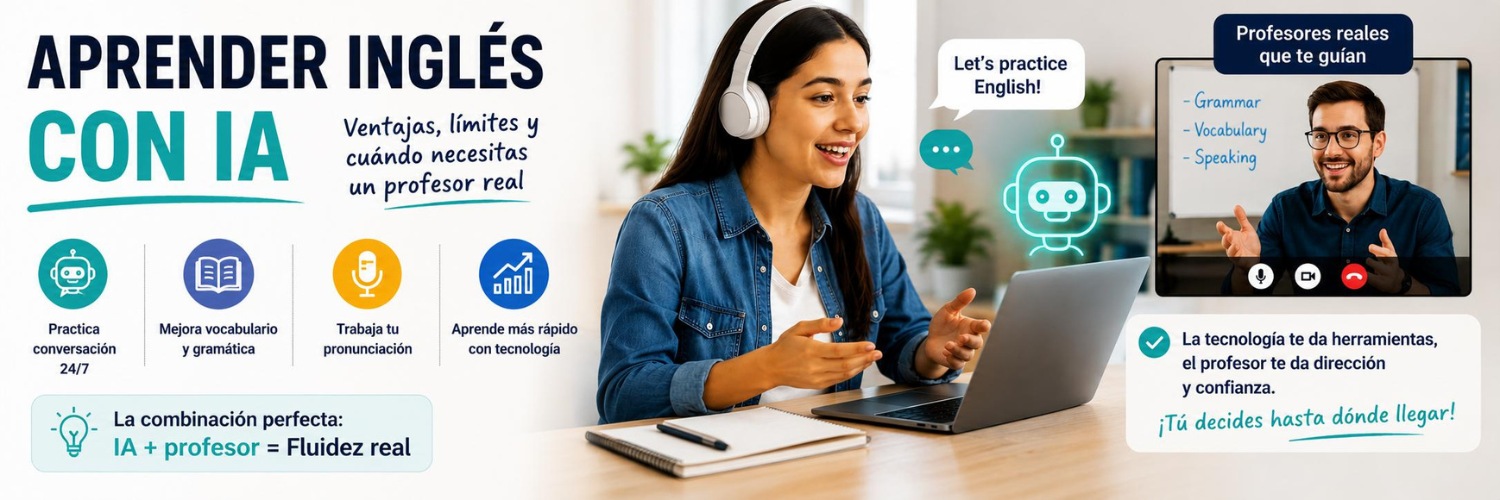
Learning English with AI: Benefits and Limitations
Artificial intelligence (AI) is transforming the way we learn languages. Today, there are tools that can correct your writing, answer questions, create personalized exercises, and even hold conversations in English anytime, anywhere.
As a result, many people are asking: Can you really learn English using only artificial intelligence?
The short answer is yes—but with some important limitations. AI can be a powerful tool to accelerate your learning, but there are still key aspects of language acquisition that are best developed through guidance from a teacher and real human interaction.
Let’s explore how to make the most of both.
How AI Can Help You Learn English
Practice English Anytime
One of AI’s biggest advantages is availability. You can practice whenever you want, wherever you are, without needing to schedule lessons.
For example, you can use tools like ChatGPT to:
- Hold conversations in English.
- Simulate real-life situations.
- Practice job interviews.
- Get help with vocabulary and grammar questions.
Many learners also feel more comfortable practicing with AI because they’re less afraid of making mistakes.
Improve Vocabulary and Grammar
Artificial intelligence can explain grammar rules in simple terms, correct mistakes, and generate exercises tailored to your level.
If you don’t understand a structure or a new word, you can receive immediate explanations and personalized examples.
This makes learning more efficient and independent.
Work on Your Pronunciation
Many modern apps include speech recognition technology that analyzes your pronunciation and helps identify sounds you need to improve.
While these tools don’t fully replace real conversation, they provide an excellent foundation for developing clearer pronunciation.
What AI Still Can’t Replace
Real Human Conversations
Speaking with another person involves much more than creating grammatically correct sentences.
Authentic conversations include:
- Emotions.
- Spontaneous reactions.
- Different accents.
- Varying speaking speeds.
- Natural expressions and cultural nuances.
These elements are difficult for AI to fully replicate.
Deep Personalized Feedback
An experienced teacher can identify recurring mistakes and learning patterns that automated tools may overlook.
A teacher can also adapt lessons to your specific goals, whether you want to improve your English for work, travel, international exams, or everyday communication.
Building Confidence in Real-Life Situations
Many learners discover they can communicate comfortably with AI but feel nervous when speaking to actual people.
Fluency develops through real interactions, learning how to respond naturally, and building confidence through experience.
How to Use AI to Learn English: Prompts You Can Copy and Paste
Artificial intelligence becomes much more effective when you know how to give it clear instructions. Here are some prompts you can use based on your learning goals.
If You Want to Improve Your Conversation Skills
Prompt:
Act as an English teacher. Have a conversation with me about travel. Correct my mistakes at the end of each response and explain them in a simple way.
If You Want to Improve Your Pronunciation
Prompt:
Act as an English pronunciation coach. Give me 10 common American English phrases. Show me the pronunciation and explain which sounds are usually difficult for Spanish speakers.
If You Want to Learn New Vocabulary
Prompt:
Teach me 15 English words and expressions related to job interviews. Include the meaning, pronunciation, and an example sentence for each one.
If You Want to Start Thinking in English
Prompt:
Ask me simple questions about my daily routine. I want to answer only in English. Correct my mistakes and suggest more natural ways to express my ideas.
If You Want to Prepare for a Job Interview
Prompt:
Simulate a job interview in English for a position as a [job title]. Ask me one question at a time and correct my answers as if you were a professional recruiter.
If You Want to Practice Real-Life Situations
Prompt:
Pretend I am a tourist at an airport in the United States. Speak only in English and help me respond naturally.
If You Want to Improve Your Writing
Prompt:
Correct this English text. Explain every grammar, vocabulary, and style mistake, and show me a more natural version written by a native speaker.
If You Want to Practice English for Your Profession
Prompt:
Act as an English specialist for [your profession]. Teach me vocabulary, expressions, and real-life situations I would encounter in my work.
When Is AI Enough and When Do You Need a Teacher?
AI is ideal for:
- Daily practice.
- Quick questions.
- Vocabulary building.
- Writing correction.
- Grammar reinforcement.
However, working with a teacher is highly recommended if you want to:
- Speak fluently.
- Improve advanced pronunciation.
- Prepare for international exams.
- Develop real conversation skills.
- Receive personalized feedback.
The Best Strategy: Combine AI and Teachers
The truth is that you don’t have to choose between artificial intelligence and teachers.
The most effective approach is often combining both.
AI helps you practice more often, solve questions instantly, and stay consistent. A teacher, on the other hand, provides guidance, corrects mistakes, and prepares you to communicate confidently in real-life situations.
Artificial intelligence has created exciting new opportunities to learn English in a more flexible and accessible way. However, its greatest value lies in complementing the learning process—not replacing the human experience.
You can use AI to practice conversation, expand your vocabulary, improve pronunciation, and strengthen your grammar every day. But if your goal is to develop real fluency, build confidence, and communicate naturally in professional or everyday situations, the guidance of a teacher remains incredibly valuable.
The best strategy is not choosing between technology and classes—it’s taking advantage of both.
At English Advance, we help students combine the power of artificial intelligence with real-life practice, personalized feedback, and authentic conversations so they can achieve their goals faster.
👉 Want to find the best learning plan for your level and goals? Contact us here: https://englishadvance.com.pe/contactanos
We will only post your name and comment, not your email address.
 (1).png)

.jpg)